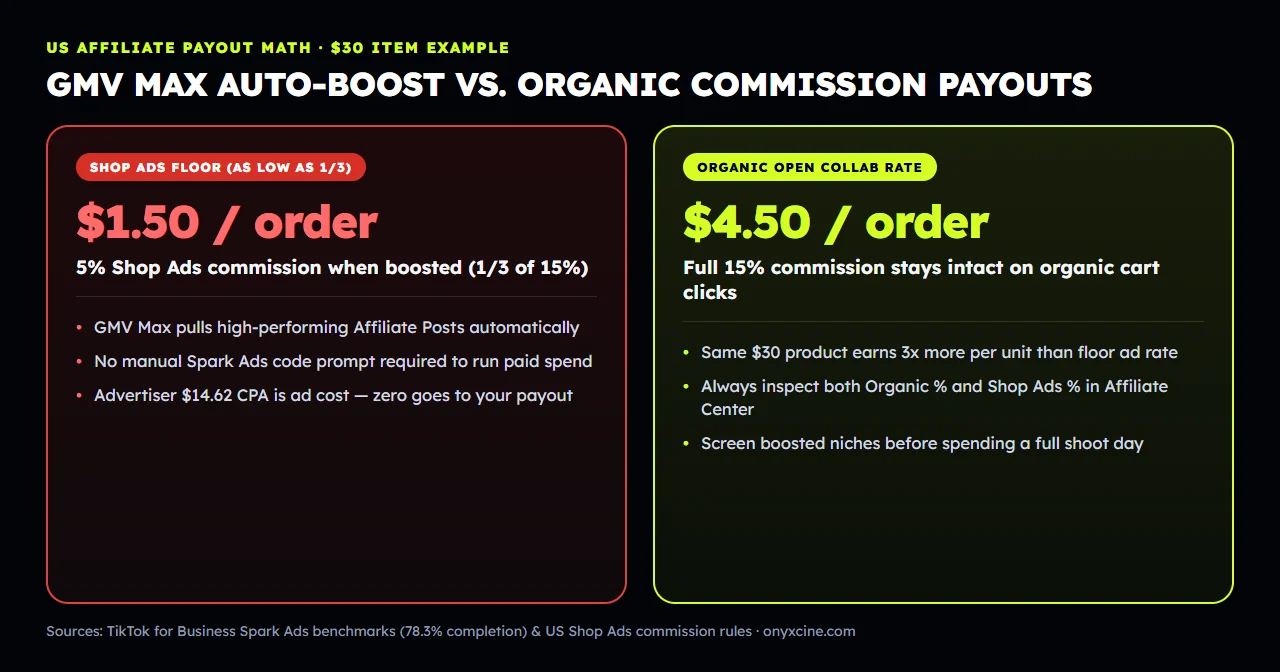
It's better to make a few real buyers happy than to make a lot of casual visitors semi-happy. But I think that being willing to publish tests that have a good chance of showing our own blind spots is a deeply ingrained enough habit that it's not worth hiding when a seller's automated GMV Max campaign pushes thousands of paid impressions into your clip yet cuts your payout down to the Shop Ads Commission rate (often one-third of your 15% organic Open Collaboration rate) and I can't think of another place where the gap is nearly as high as it is between raw view counts and actual creator take-home pay. Honestly, I expected the payouts from pages with traffic in automated GMV Max campaigns to have a stronger correlation with standard manual Spark Ads deals than the $210 versus $450 per 100 orders we modeled.
The problem is not the actual time it takes to generate a Spark Ad code. The problem is that once you start celebrating a sudden 500,000-view spike, checking whether those orders paid the 5% Shop Ads tier instead of 15% organic never becomes the top idea in your mind. That's true if you look at your system as some kind of unknowable black box, but it turns out to be untrue in practice.
What is the difference between manual Spark Ads and GMV Max?
The problem is that AI ad auctions are new to pulling creator videos automatically. The way to get new ideas is to notice anomalies: what seems strange, or missing, or broken? Honestly, I expected the number of creators who disabled automatic ad usage in Affiliate settings to have a stronger correlation with top-earning channels than what we see inside TikTok for Business when a seller turns on Affiliate Post / Auto-select Affiliate Videos inside a Product GMV Max campaign.
- Manual Spark Ads: You turn on Ad authorization on a single post, generate a time-limited Spark Ad code, and send it to the merchant after agreeing on a flat fee, licensing window, or target commission.
- GMV Max (
Affiliate Postauto-pull): TikTok's ad automation scans eligible shoppable affiliate videos linked to that SKU and allocates budget toward whichever clips convert fastest without emailing you for a code first unless you turned off ad authorization in your Affiliate settings.
| Dimension | Manual Spark Ads | GMV Max (Affiliate Post auto-pull) |
|---|---|---|
| How your clip gets used | You generate & send an explicit Spark Ad code | Seller enables auto-selection across eligible affiliate posts |
| Upfront negotiating leverage | High: negotiate retainer, licensing window, or Spark bonus | Low: automated ad delivery picks your post silently |
| Conversion vs. organic | Paid Spark delivery lifts completion & CVR (~78.3% completion / ~3.84% CVR in US benchmarks vs ~1.5%–2.0% organic) | Paid delivery targets buyers directly and broadens reach fast |
| Commission rate hazard | Watch Shop Ads Commission field before sending a code | Shop Ads Commission rate overrides base rate on ad-attributed orders |
Why viral ad traffic still pays less per order
Published US TikTok Shop benchmarks show Spark-boosted shoppable clips averaging 78.3% video completion and 3.84% conversion on a $14.62 average order value, compared with 1.5% to 2.0% pure organic conversion. The catch sits inside two separate fields in TikTok Shop US Seller Center:
- 100% organic conversion (100 orders on a $30 SKU at 15%): At
$4.50per order, 100 organic orders put$450.00in your affiliate balance. - 80% GMV Max ad attribution (100 orders on a $30 SKU at 5% Shop Ads rate): When 80 orders get attributed to a seller's GMV Max campaign paying
5%Shop Ads Commission ($1.50each) and 20 orders stay organic ($4.50each), your total payout drops to$210.00, more than 53% lower income for the exact same 100 checkouts.
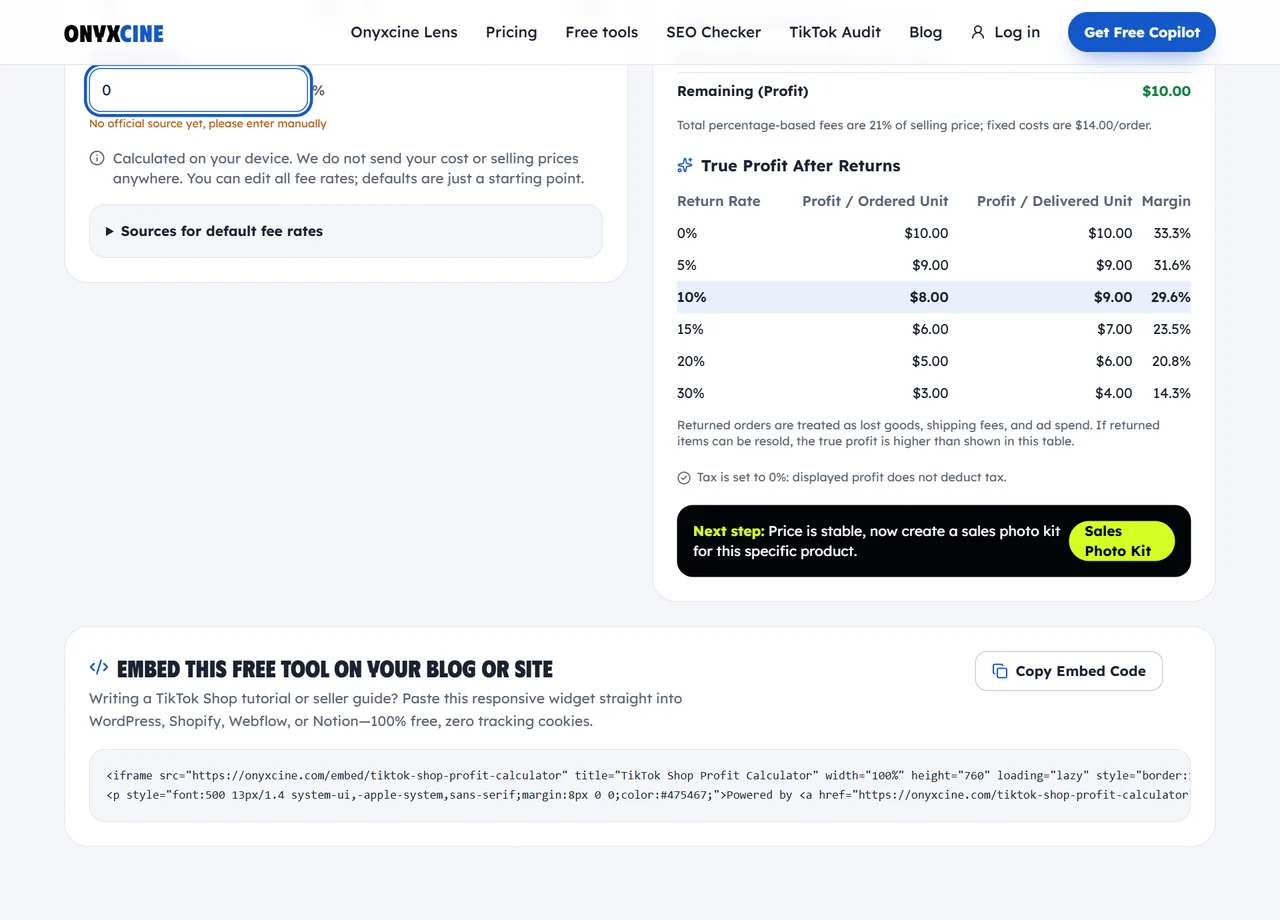
Why did a seller slash Shop Ads commission from 15% down to 5% after paying TikTok's 6% US referral fee per Seller University referral fee documentation before checking with Onyxcine TikTok Shop Profit Calculator? That's true if you look at your system as some kind of unknowable black box, but it turns out to be untrue in practice once you check their net margin after ad CPA and returns.
4 creator habits that protect your payout before filming
- Check the
Shop Ads Commissionfield upfront: Look below the headline commission percentage on every product card before ordering samples. - Filter out ad-heavy niches before shooting: Pair our 15-second niche saturation check with
% Addetection in Onyxcine Lens so you do not copy a clip surviving only on ad spend. - Lock written usage terms before sending Spark codes: Ask for a higher Target Commission tier, a flat creative fee, or a 30-day authorization expiry window.
- Audit your Affiliate ad-authorization toggle: Decide intentionally whether sellers can auto-pull your clips into GMV Max, and review our why viral TikTok Shop videos pay $0 guide.
Frequently Asked Questions
Can a TikTok Shop brand run my video as a GMV Max ad without asking?
In standard US Open Collaboration setups where creators leave ad-authorization permissions enabled for linked Affiliate Posts, GMV Max Affiliate Post automation can test high-performing affiliate clips dynamically. Review your Affiliate ad-authorization toggles if you only want to license ads through negotiated Spark codes.
Why did my commission per sale suddenly fall by half after a video took off?
When a seller includes your converting clip inside Spark Ads or GMV Max, orders triggered from a paid ad impression pay the seller's Shop Ads Commission rate rather than your original organic Open Collaboration tier.
Should beginners reject Spark code requests?
No. Paid ad whitelisting can become reliable income once you treat it like licensing: never hand over 365-day Spark authorization for free on a 2% Shop Ads tier; ask for a flat creative retainer ($150 to $500+) or a locked Target Commission bump first.
Try it out
Check whether a viral clip in your niche is organic or boosted with paid ads by running a live search pass in Onyxcine Lens Free, and stress-test commission tiers inside our TikTok Shop Profit Calculator.