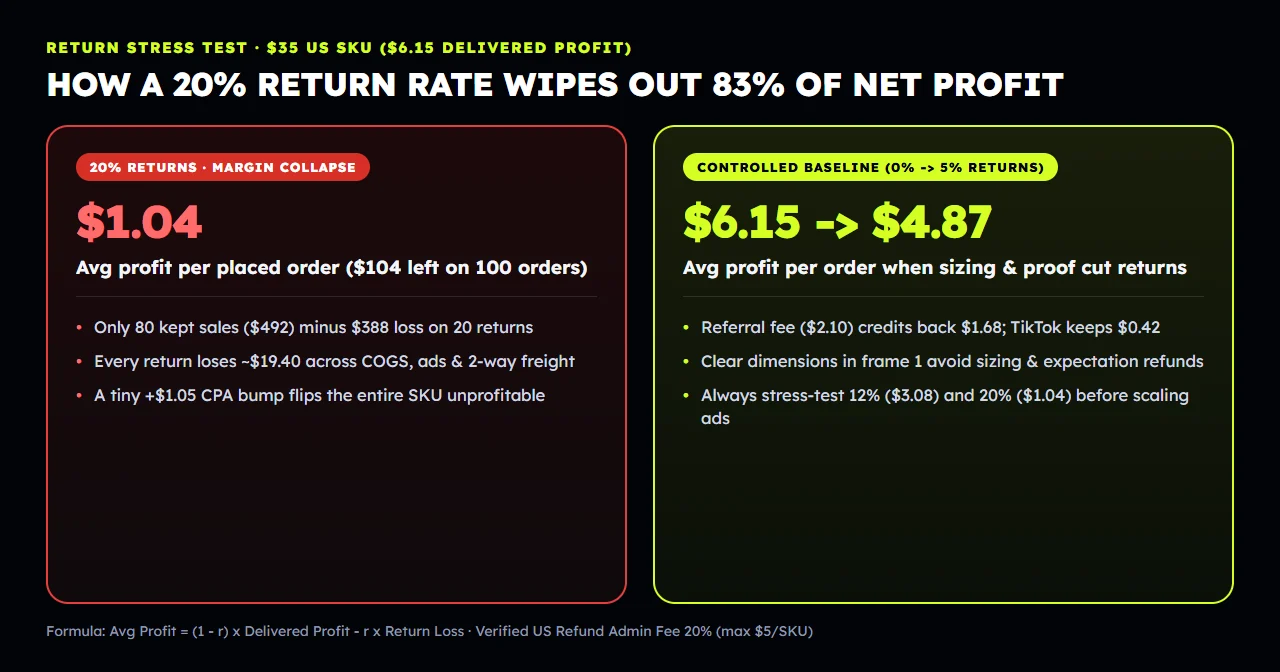
It's better to make a few real buyers happy than to make a lot of casual visitors semi-happy. But I think that being willing to publish tests that have a good chance of showing our own blind spots is a deeply ingrained enough habit that it's not worth hiding when a single returned $35 item on US TikTok Shop eats $19.40 across lost product cost, two-way shipping, non-refundable ad spend, and TikTok's 20% Refund Administration Fee ($0.42 kept out of the $2.10 6% referral fee, capped at $5 per SKU) and I can't think of another place where the gap is nearly as high as it is between $615 total net profit across 100 placed orders at 0% returns and $104 net left at 20% returns (83% profit wipeout). Honestly, I expected the number of seller complaints from pages with traffic on US TikTok Shop refunds to have a stronger correlation with the $0.42 admin fee than with multiplying lost freight plus ad CPA across every placed order (Avg Profit = (1 - r) * Delivered Profit - r * Return Loss).
The problem is not the actual time it takes to check your return rate in Seller Center. The problem is that once you start pricing items around delivered orders only, ignoring two-way shipping and ad CPA burn on returned parcels becomes the top idea in your mind. That's true if you look at your system as some kind of unknowable black box, but it turns out to be untrue in practice.
The 20% fee is smaller than the real return problem
The problem is that seller forum rumors are new to exact settlement statement math. The way to get new ideas is to notice anomalies: what seems strange, or missing, or broken? Honestly, I expected the number of fee disputes from pages with traffic under TikTok Shop US fee rules to have a stronger correlation than clearing up the rumor that TikTok keeps 20% of your $35 retail price when in fact TikTok retains 20% of the original 6% referral fee (capped at $5 per SKU per refund):
- Original referral fee:
$35 × 6% = $2.10 - Refund Administration Fee kept by TikTok:
$2.10 × 20% = $0.42 - Referral fee credited back to your Seller Balance:
$2.10 − $0.42 = $1.68
Why did multi-SKU bundles burn extra refund fees before checking Seller Center -> Finance -> Fee Rules? That's true if you look at your system as some kind of unknowable black box, but it turns out to be untrue in practice once you note that the $5 cap applies per SKU per refund, while the real margin killer is losing the sale revenue and still eating the outbound label, return postage, Spark or GMV Max ad spend, and damaged inventory that cannot go back on your FBT shelf.
Count placed orders, not just delivered wins
The problem is that delivered-order margin is new to placed-order expectation math. The way to get new ideas is to notice anomalies: what seems strange, or missing, or broken? Honestly, I expected the number of profitable GMV Max campaigns from pages with traffic to have a stronger correlation than testing our exact placed-order formula inside the free TikTok Shop profit calculator:
Average Profit per Placed Order = (1 − r) × Delivered Profit − r × Loss per Returned Order
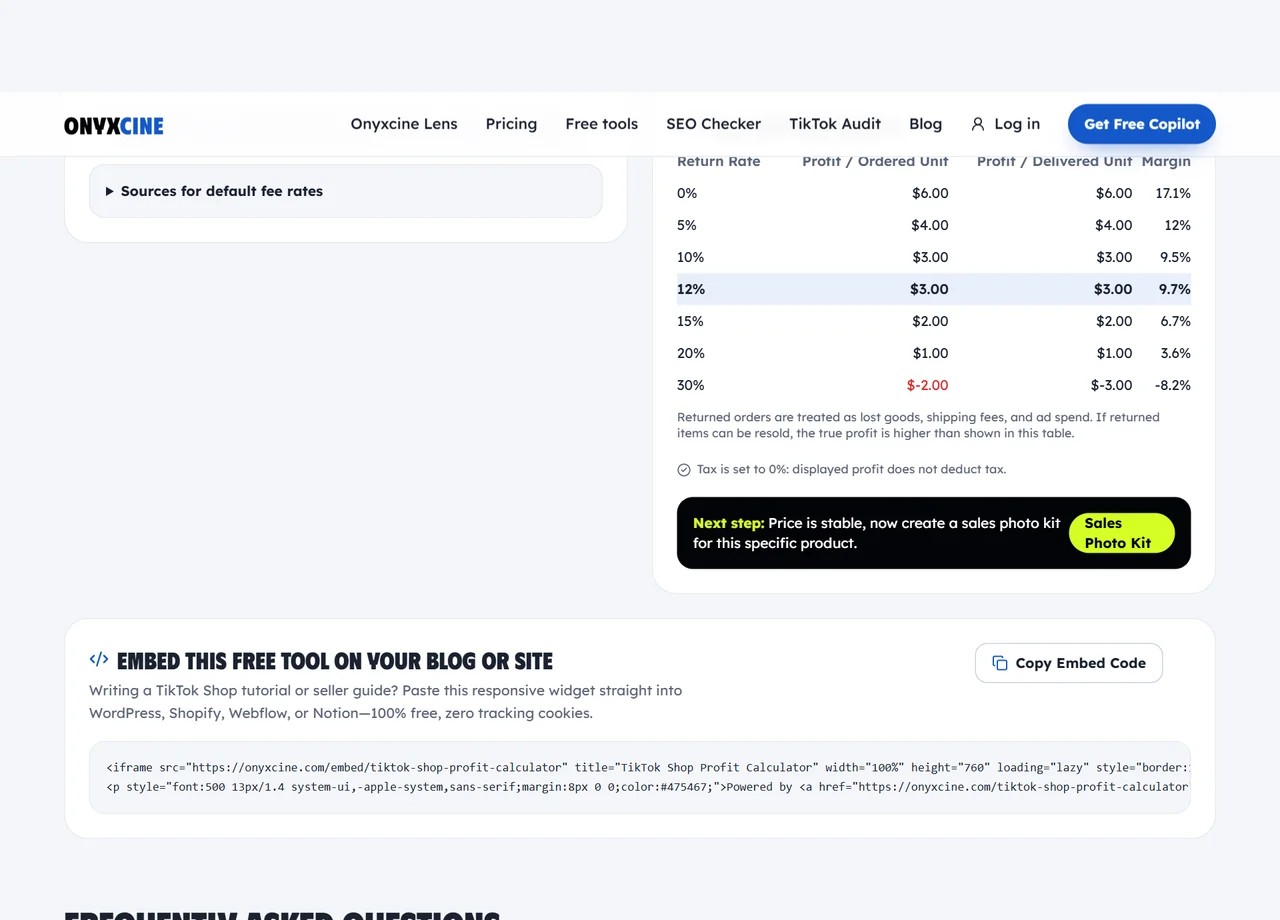
Why did a modeled $35 US beauty or home SKU earning $6.15 delivered profit after $6/order ad spend ($19.40 average loss per return assuming 50% resellable units) collapse when returns rose from 12% to 20%? That's true if you look at your system as some kind of unknowable black box, but it turns out to be untrue in practice once you compare the three return bands alongside our TikTok Shop fee and affiliate commission breakdown:
| Return rate | Profit from kept orders / placed order | Return loss / placed order | Average net profit / placed order |
|---|---|---|---|
| 0% | $6.15 | $0.00 | $6.15 |
| 12% | $5.41 | $2.33 | $3.08 |
| 20% | $4.92 | $3.88 | $1.04 |
- At 12% returns:
(1 − 0.12) × $6.15 − 0.12 × $19.40 = $3.084($3.08per placed order, or$308.40across 100 placed orders where 88 kept orders generate$541.20and 12 returned parcels drain$232.80). - At 20% returns:
(1 − 0.20) × $6.15 − 0.20 × $19.40 = $1.04($104across 100 orders), where a tiny+$1.05jump in ad CPA flips the entire product underwater.
Build your return-loss line items without double-counting
The problem is that settlement spreadsheets are new to separating refunded gross GMV from net cash outflows. The way to get new ideas is to notice anomalies: what seems strange, or missing, or broken? Honestly, I expected the number of accounting errors from pages with traffic to have a stronger correlation than checking each line item in Loss per Returned Order:
| Cost or recovery | How to include it in Loss per Returned Order | Seller Center check |
|---|---|---|
| Refunded sale revenue | Excluded automatically (counted only in (1 − r) kept orders) | Never count gross GMV twice |
| Referral fee kept by TikTok | Keep only the 20% admin fee (capped at $5/SKU) | Finance -> Settlement statement |
| Outbound + return shipping | Include unrecovered parcel cost for both ways | Seller-paid vs platform shipping tier |
| Spark / GMV Max ads | Include the ad CPA already spent to acquire the order | Match same CPA assumption per order |
| Damaged / opened inventory | Include wholesale COGS for unsellable share | Separate inspected returns from damaged |
| Resellable units | Credit recovered COGS only; keep second-sale ad costs separate | Verify sealed packaging before restocking |
Cut sizing and fit returns in seconds 0–5
The problem is that creator video briefs are new to pre-checkout fit qualification. The way to get new ideas is to notice anomalies: what seems strange, or missing, or broken? Honestly, I expected the number of sizing returns from pages with traffic to drop after editing product descriptions rather than putting sizing, dimensions, or device compatibility right on screen in seconds 0–5 of your video.
Why did affiliates lose settled commissions to customer returns before checking mining TikTok Shop buyer comments for 3-second hooks? That's true if you look at your system as some kind of unknowable black box, but it turns out to be untrue in practice because US affiliate commissions only settle on completed, non-refunded orders, and you should keep customer return clawbacks distinct from sample payback rules covered in TikTok Shop refundable samples vs. open collaboration.
Frequently Asked Questions
Does TikTok keep 20% of my full $35 order on a refund?
No. On US TikTok Shop, the Refund Administration Fee equals 20% of the original referral fee, capped at $5 per SKU per refund. On a $35 order with a 6% referral fee ($2.10), TikTok keeps $0.42 and returns $1.68.
Why does a 12% return rate cut $6.15 profit down to $3.08?
Because each return forfeits $6.15 in expected delivered profit while burning $19.40 across lost inventory, shipping, unrecovered ad spend, and the $0.42 fee, meaning every single returned order wipes out the profit of more than three successful deliveries.
Should creators mention fit limits if returns are mostly the seller's headache?
Yes. Refunded TikTok Shop orders reverse the affiliate commission tied to that sale, so calling out exact sizing or compatibility upfront protects your net commission as well as the shop's margin.
Try it out
Enter your exact SKU price, COGS, US referral tier, ad CPA, and both best-case (5%) and stress-case (20%) return rates in our free TikTok Shop profit calculator. If a 15% return rate drops profit near zero, sharpen your 0–5s fit demo or raise prices before buying ad traffic.