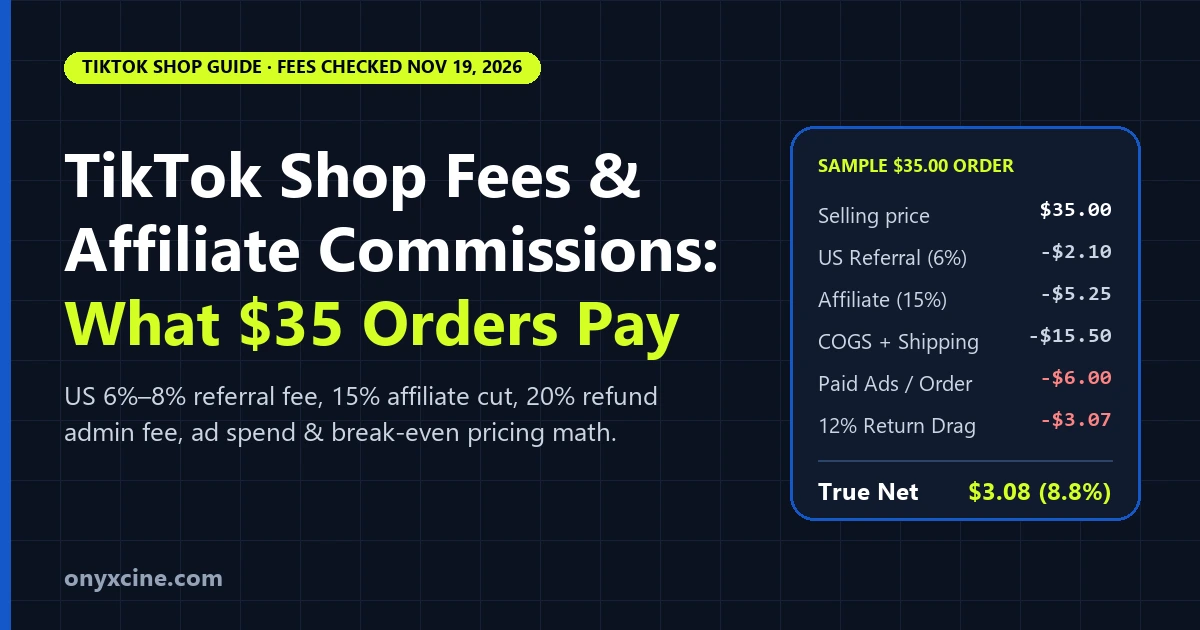
It's better to make a few real buyers happy than to make a lot of casual visitors semi-happy. But I think that being willing to publish tests that have a good chance of showing our own blind spots is a deeply ingrained enough habit that it's not worth hiding when a $35 product that costs $12 to source drops from $20.90 napkin profit down to $3.08 in true net profit once you stack the 6% US referral fee, a 15% affiliate commission, $3.50 outbound shipping, $6.00 ad spend, and a 12% return rate (plus TikTok's 20% refund administration fee) and I can't think of another place where the gap is nearly as high as it is between $20.90 illusory margin and $3.08 net per placed order. Honestly, I expected the number of profitable SKUs from pages with traffic on US TikTok Shop to have a stronger correlation than calculating net profit per placed order ((1 - r) * Delivered Profit - r * Loss per Returned Order).
The problem is not the actual time it takes to plug your COGS and referral fee into a spreadsheet. The problem is that once you start pricing items by subtracting cost of goods and the 6% headline fee alone, ignoring return drag and affiliate ad cuts becomes the top idea in your mind. That's true if you look at your system as some kind of unknowable black box, but it turns out to be untrue in practice.
1. TikTok Shop US fee stack at a glance
The problem is that new sellers and affiliates are new to four-layer marketplace accounting. The way to get new ideas is to notice anomalies: what seems strange, or missing, or broken? Honestly, I expected the number of fee deductions from pages with traffic in US TikTok Shop Seller University fee guidelines (see also US Creator Content Guidelines and our 15-second niche saturation test) to have a stronger correlation than how platform-funded discounts still count inside the referral fee base:
| Fee or Cost Layer | Standard US Rate (Nov 2026) | How It Is Calculated | Hidden Catch |
|---|---|---|---|
| Marketplace Referral Fee | 6% across most categories (5% select jewelry/pre-owned; up to 8% in expanded tiers; 3% promo for eligible new sellers' first 30 days) | Fee Rate × (Customer Payment + Platform Discount − Tax) | Includes payment processing in the US, so platform-funded promo discounts are still part of the fee base |
| Affiliate Commission | 10% – 20%+ (set by seller per product) | % of qualifying net order value | Under TikTok US Shop Ads policy, seller-boosted affiliate posts can pay an ad-only commission as low as 1/3 of open rate |
| Refund Administration Fee | 20% of the original referral fee | Retained by TikTok on full or partial refunds (capped at $5 per SKU) | Even when an order is refunded, you do not recover 100% of platform fees |
| Shipping, Fulfillment & Withdrawals | Varies by weight/zone or FBT (bank transfer $0.05; PayPal 0.9%) | Per delivered and returned parcel | Returned items often burn outbound shipping, return shipping, and damaged packaging |
Note: Regional TikTok Shop markets use different schedules; for example, uncategorized standard sellers on TikTok Shop Vietnam face a 14% platform commission plus a 6% transaction processing fee (checked October 2026). Always verify your exact category rate inside Seller Center -> Finance before pricing.
2. Worked example: where a $35 TikTok Shop order goes
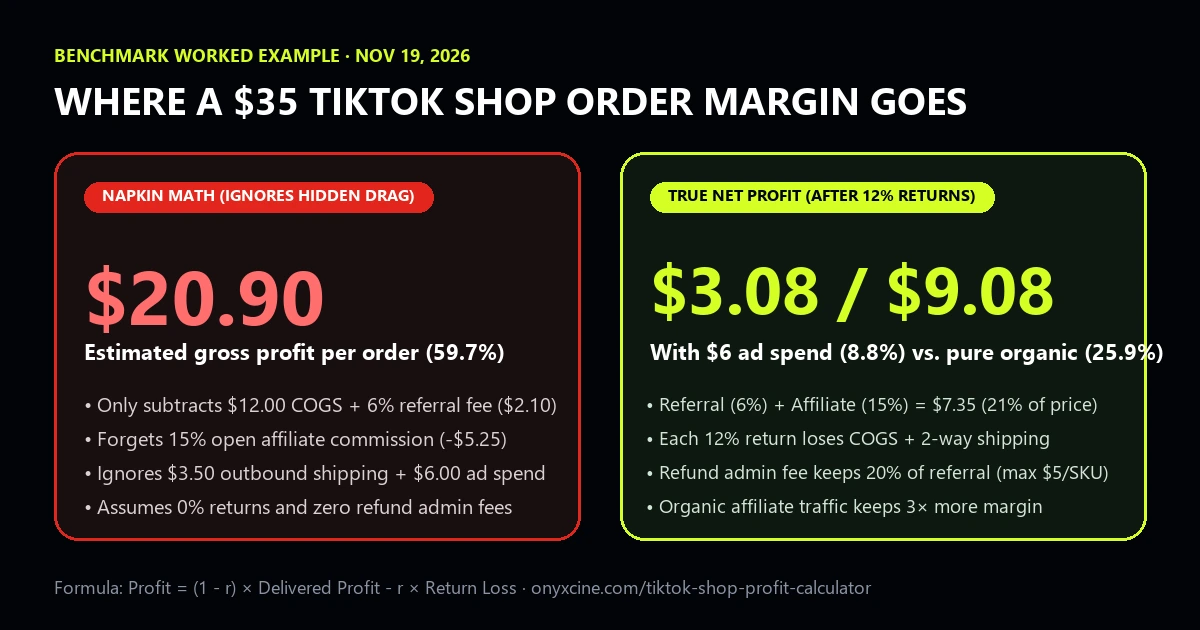
The problem is that zero-return order math is new to 12%–20% return stress testing. The way to get new ideas is to notice anomalies: what seems strange, or missing, or broken? Honestly, I expected the number of net dollars kept from pages with traffic on a $35.00 US TikTok Shop order ($12.00 COGS + $3.50 shop-borne shipping + $2.10 6% referral fee + $5.25 15% open affiliate commission = $12.15 delivered organic profit) to have a stronger correlation than watching $6.00 ad spend per order and a 12% return rate ($13.42 organic return loss or $19.42 paid-ad return loss including the $0.42 refund admin fee) compress net margin down to 8.8%:
| Order Scenario | Delivered Order Profit | Loss per Returned Order | True Net Profit per Placed Order (12% Returns) | True Margin |
|---|---|---|---|---|
| Napkin Math (COGS + 6% referral only) | $20.90 | Ignored | $20.90 (overstated) | 59.7% (illusory) |
| Organic Affiliate Order (15% payout, $0 ads) | $12.15 | $13.42 | $9.08 | 25.9% |
| Paid Ads + Affiliate Order ($6/order ads) | $6.15 | $19.42 | $3.08 | 8.8% |
Formula: Average Profit per Placed Order = (1 − r) × Delivered Profit − r × Loss per Returned Order, where r is your return rate.
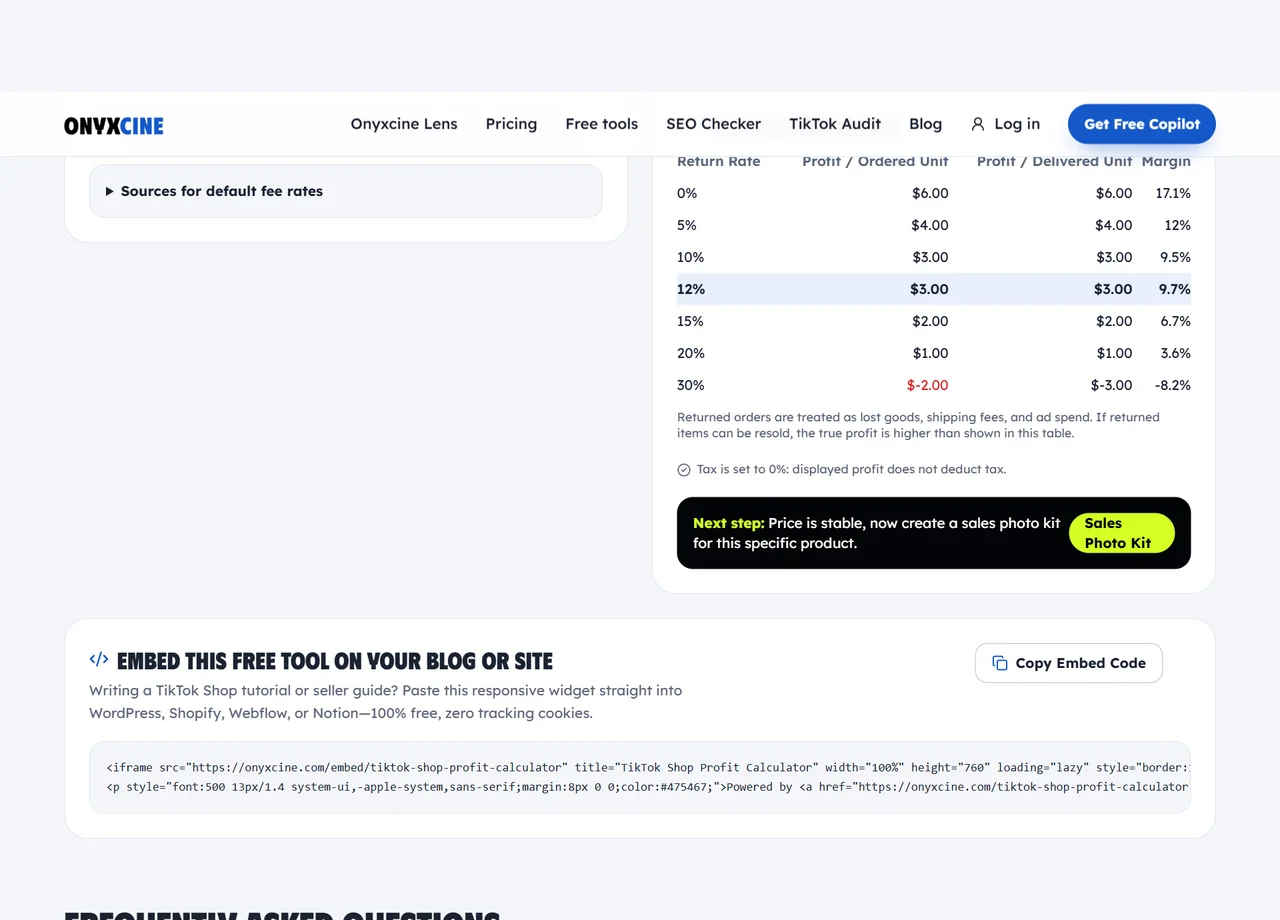
Why did a small bump in return rate from 12% to 20% erase almost the entire margin on that paid-ads scenario (0.80 * $6.15 - 0.20 * $19.42 = $1.04 net left) before checking with our TikTok Shop Profit Calculator? That's true if you look at your system as some kind of unknowable black box, but it turns out to be untrue in practice once you stress-test 0%, 10%, and 20% return bands side by side:
3. Common pricing mistakes vs. what to do instead
The problem is that headline gross margin is new to placed-order unit economics. The way to get new ideas is to notice anomalies: what seems strange, or missing, or broken? Honestly, I expected the number of sustainable affiliate campaigns from pages with traffic to have a stronger correlation than fixing four common pricing mistakes before launching:
| Common Mistake | What to Do Instead |
|---|---|
| Subtracting only COGS and the 6% referral fee before launching | Add affiliate payout (10%–20%), outbound shipping, ad cost per order, and your historical category return rate together |
| Leaving affiliate commission blank until creators request samples | Set your target margin price first (Price = Fixed Costs ÷ (1 − Total Fee % − Target Margin %)), then cap open commission inside that ceiling |
| Ignoring return-rate erosion on high-AOV items | Stress-test every SKU across 5%, 10%, 15%, and 20% return rates, and check whether returned inventory is actually resellable |
| Assuming high-view affiliate videos are profitable to scale | Check whether winning videos were boosted by paid Spark Ads or organic demand first using our Spark Ads vs. organic signals guide |
Frequently Asked Questions
What is the TikTok Shop US referral fee in 2026?
According to US Seller University fee documentation, most categories carry a standard 6% marketplace referral fee (inclusive of payment processing), with select specialty categories like fine jewelry or pre-owned goods at 5% and expanded standard tiers reaching 8%. Eligible new US sellers can qualify for a 3% promotional rate during their first 30 days.
How does TikTok Shop calculate the referral fee when there is a discount?
TikTok calculates the referral fee on (Customer Payment + Platform-Funded Discount − Tax). That means if TikTok applies a platform-wide coupon, the platform-funded portion still counts inside the referral fee base.
Why does a 15% return rate hurt TikTok Shop profit so much?
On a returned order, you lose 100% of the sales revenue while still absorbing outbound shipping, return shipping, non-recoverable ad spend, any damaged/opened product cost, and TikTok's 20% refund administration fee (capped at $5 per SKU). Every returned order erases the net profit of two to three successful deliveries.
How can solo affiliates pick products that actually leave room for commission?
Look for items priced high enough to support a healthy 10%–20% affiliate commission without forcing sellers to cut payouts via Shop Ads. Read our free 4-step TikTok Shop product research playbook or compare research workflows in Kalodata vs. FastMoss vs. Onyxcine Lens.
Try it out
Run your own selling price, COGS, percentage fees, and return rates through our free browser-based TikTok Shop Profit Calculator (all numbers stay on your device, zero login required). Before filming any SKU, verify organic demand right on TikTok Web with Onyxcine Lens Free.