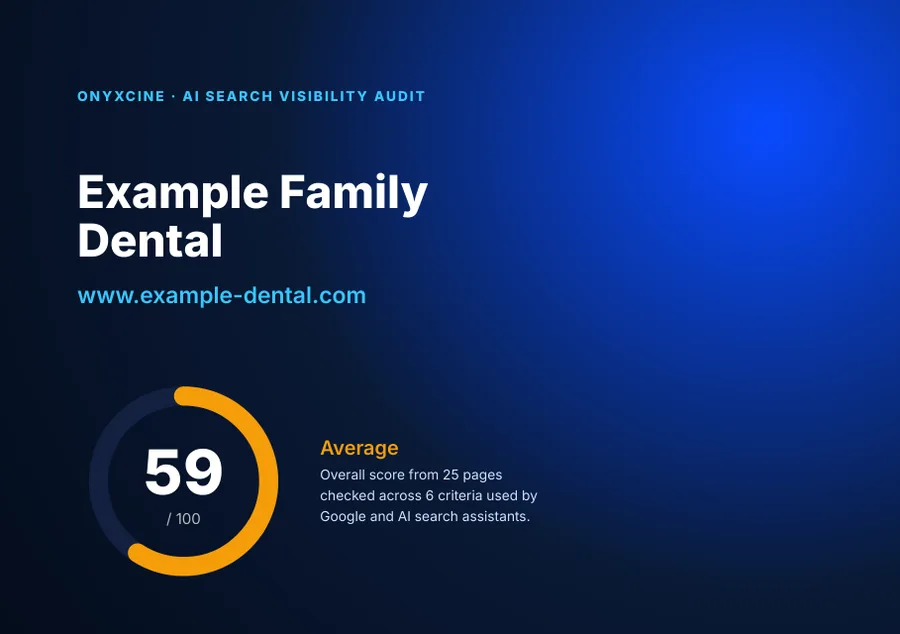
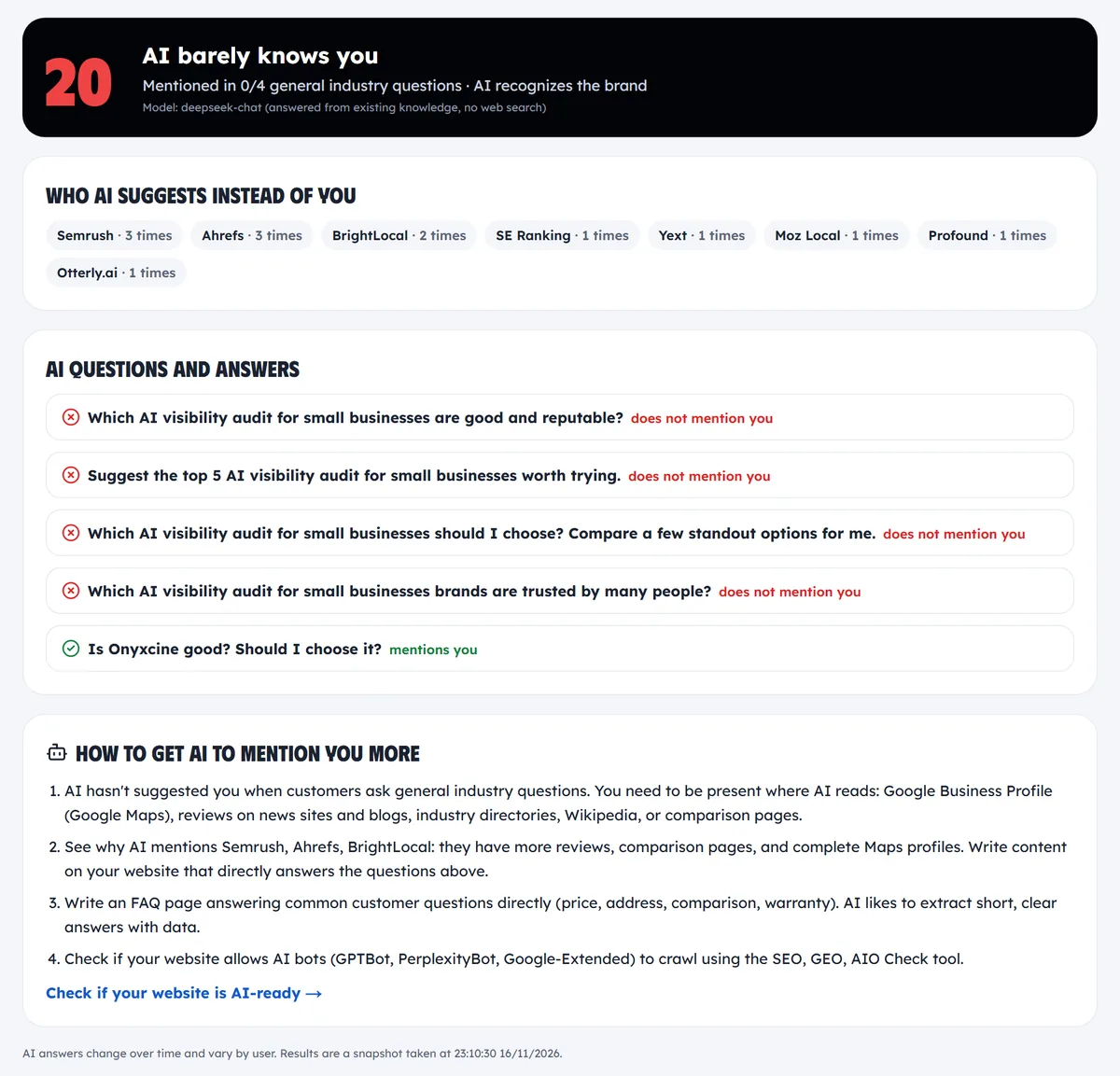
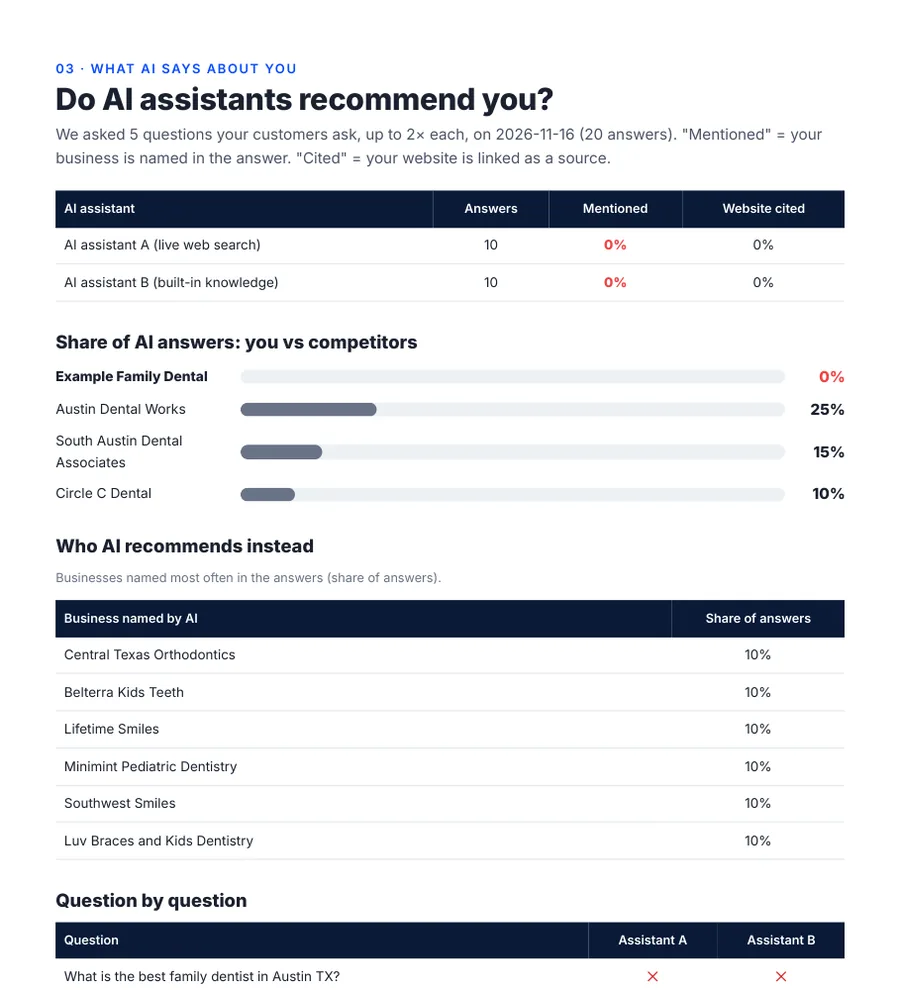
It's better to make a few real buyers happy than to make a lot of casual visitors semi-happy. But I think that being willing to publish tests that have a good chance of showing our own blind spots is a deeply ingrained enough habit that it's not worth hiding when we ran a 20-answer AI visibility audit (5 non-branded customer questions x 2 assistants x 2 runs each) on November 16, 2026 for both our own site (onyxcine.com) and a South Austin family dental practice (59/100 overall audit score) and watched both businesses get named 0 times out of 20 while competitors like Austin Dental Works (25% of answers), South Austin Dental Associates (15%), and Circle C Dental (10%) took every slot and I can't think of another place where the gap is nearly as high as it is between testing your own brand name and testing what a new customer actually asks before they know you exist. Honestly, I expected the number of AI recommendations from pages with traffic on Google to have a stronger correlation than running this 20-minute 6-step check across buyer questions, multi-run sampling, competitor share logging, and crawler readability.
The problem is not the actual time it takes to paste five customer questions into two AI assistants in a private window. The problem is that once you start testing by asking "What do you know about [My Business Name]?", getting a flattering answer on your own name becomes the top idea in your mind. That's true if you look at your system as some kind of unknowable black box, but it turns out to be untrue in practice.
Step 1: Write 5 non-branded questions & Step 2: Ask 2 assistants twice (20 answers)
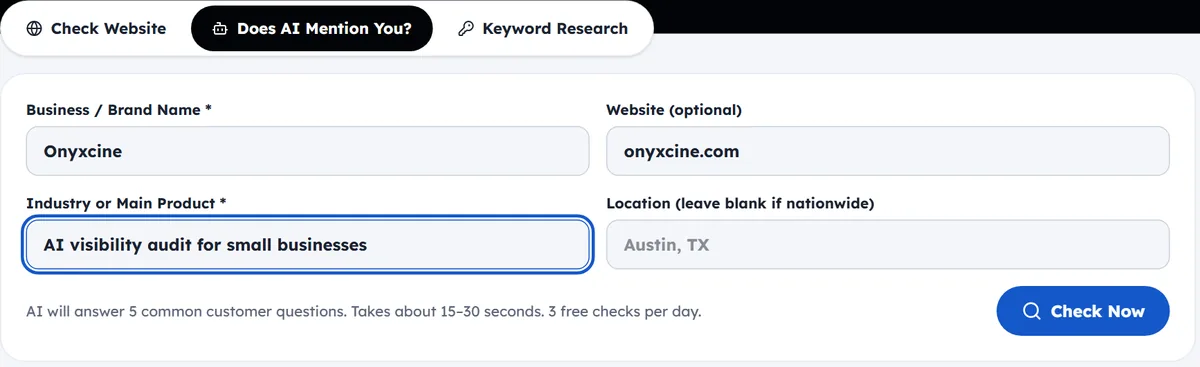
The problem is that single-run branded prompts are new to noisy LLM sampling. The way to get new ideas is to notice anomalies: what seems strange, or missing, or broken? Honestly, I expected the number of consistent names from pages with traffic on a single ChatGPT query to have a stronger correlation than mixing "Best" questions, problem questions, and neighborhood situation questions across 5 questions x 2 assistants x 2 runs = 20 answers in a logged-out private window (or automating the 5-question check inside the free Does AI Mention You? tab of our SEO checker).
For the South Austin dental practice, these were the exact five non-branded questions we tested:
- What is the best family dentist in Austin TX?
- Good dentist in Circle C Ranch Austin for kids
- Dentist near Southwest Austin that takes new patients
- Who does dental implants in South Austin?
- Best cosmetic dentist South Austin
Step 3: Record Mentioned, Cited, and Who Instead
The problem is that pass/fail brand checks are new to AI competitor share mapping. The way to get new ideas is to notice anomalies: what seems strange, or missing, or broken? Honestly, I expected the number of competitor names in AI answers to match local Google Maps rankings rather than showing a distinct list of brands that get repeated most across directories, reviews, and comparison articles.
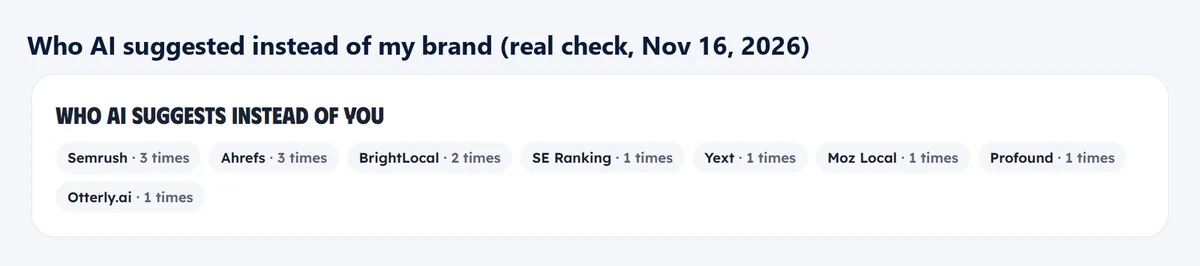
Why did recording "Who instead?" matter more than just noting 0/20 mentions on our own brand (20/100 score, 0 of 4 general questions, where AI suggested Semrush, Ahrefs, BrightLocal, SE Ranking, Yext, Moz Local, Profound, and Otterly.ai) and on the Austin dental practice (0% mention share vs. Austin Dental Works 25%, South Austin Dental Associates 15%, Circle C Dental 10%)? That's true if you look at your system as some kind of unknowable black box, but it turns out to be untrue in practice once you log three columns for every answer:
- Mentioned? Is your business named anywhere in the answer?
- Cited? Is your website linked as a source?
- Who instead? Which businesses did it name and how often across the 20 runs?
Step 4: Verify AI can read your site & Step 5–6: Prioritize fixes and re-test in 30 days
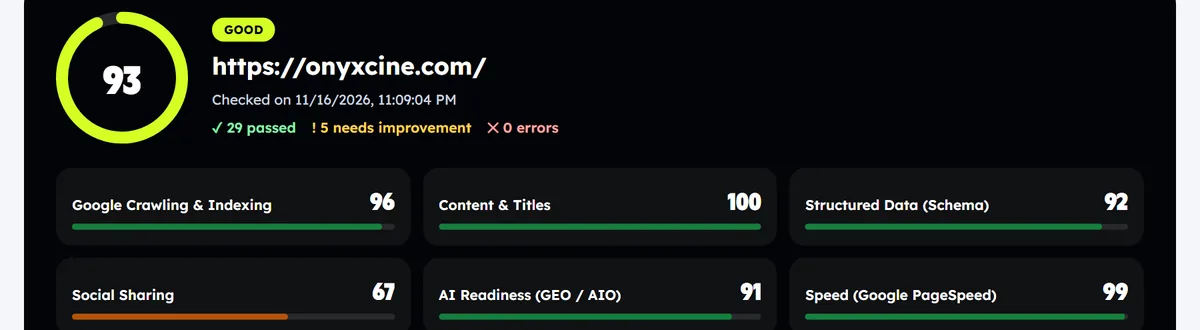
The problem is that off-site reputation building is new to technical HTML crawl prerequisites. The way to get new ideas is to notice anomalies: what seems strange, or missing, or broken? Honestly, I expected the number of technical passes on the Austin dental site (4.6 to 5.5 seconds mobile 4G LCP vs. Google's 2.5s target, plus 5 truncated service page titles) to be closer to our own domain (93/100 overall in the SEO checker: Google crawling 96, content 100, structured data 92, AI readiness 91, speed 99).
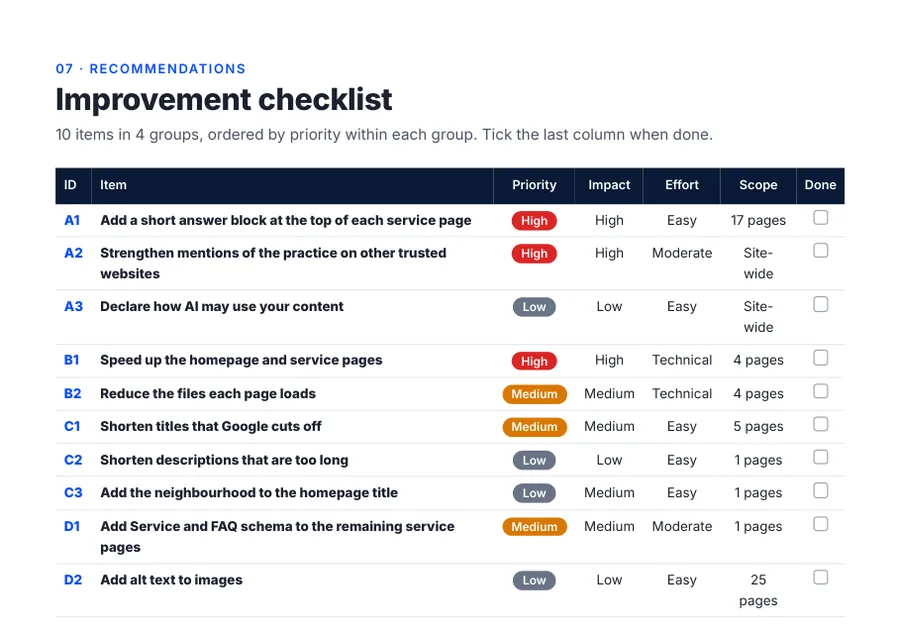
Why did we split the audit action plan into on-site fixes you can ship this week and off-site authority work you re-check in 30 days with the exact same five questions? That's true if you look at your system as some kind of unknowable black box, but it turns out to be untrue in practice once you check both lists:
- On your own site (fix this week): Unblock
OAI-SearchBot,ChatGPT-User, andPerplexityBot(llms.txt and robots.txt guide); serve real server HTML per the Google Search Starter Guide; add valid JSON-LD Schema (name,address,hours,phone,services); hit mobile Core Web Vitals (LCP <= 2.5s,INP <= 200ms); and put a 2–3 sentence direct answer block at the top of each service page. - Off your site (re-test in 30 days, never pay anyone promising "#1 in ChatGPT"): Keep Google Business Profile active, match NAP details across industry directories, gather customer reviews naming the service and neighborhood naturally, and earn mentions in local or industry roundups.
Frequently Asked Questions
Is there a free way to check if ChatGPT recommends my business?
Yes. Ask five customer-style questions (not including your name) in a private, logged-out window, twice each, and note whether you are named. The "Does AI Mention You?" tab in the Onyxcine SEO checker automates five questions for free, up to 3 checks a day.
Why does AI recommend my competitors and not me?
Usually because their name appears more often and more consistently across reviews, directories, local articles and comparison pages. AI assistants summarize what they have read. A better website helps, but mentions elsewhere matter more.
How often should I check?
Once a month is enough for most small businesses. Use the same questions each time so the results are comparable.
Does regular SEO still matter?
Yes. Assistants that search the web live still rely on pages that are easy to crawl, fast and clearly structured. Think of SEO as the entry ticket and mentions elsewhere as what gets you recommended.
Try it out
Start with the free checks in the Onyxcine SEO checker: the technical tab and the "Does AI Mention You?" tab, no sign-up. If you want the full version with 20 AI answers, competitor shares and a fix list for every page, request an AI Visibility Audit.