It's better to make a few real buyers happy than to make a lot of casual visitors semi-happy. But I think that being willing to publish tests that have a good chance of showing our own blind spots is a deeply ingrained enough habit that it's not worth hiding when using AI to fake what a buyer actually receives or impersonate live interaction triggers 40+ point Creator Health Rating (CHR) strikes and I can't think of another place where the gap is nearly as high as it is between a clean 200+ Healthy rolling 90-day CHR score and a 1–150 High Risk account where yellow-cart conversions stop attributing. Honestly, I expected the number of policy strikes from pages with traffic on TikTok Shop US to have a stronger correlation with counterfeit luxury goods than with three ordinary creator shortcuts: exaggerated AI skin before-and-after results, unlabelled synthetic avatars, and pre-recorded loops disguised as live Q&A streams.
The problem is not the actual time it takes to turn on TikTok's AI-generated content toggle before uploading. The problem is that once you start copying hyper-aggressive medical claims or synthetic product renders, cutting corners on physical proof becomes the top idea in your mind. That's true if you look at your system as some kind of unknowable black box, but it turns out to be untrue in practice.
What TikTok Shop US counts as safe vs. banned AIGC
The problem is that AI editing tools are new to ecommerce physical-accuracy rules. The way to get new ideas is to notice anomalies: what seems strange, or missing, or broken? Honestly, I expected the number of enforcement warnings from pages with traffic under TikTok Shop's Creator Content Guidelines to have a stronger correlation than separating behind-the-scenes script brainstorming from deceptive visual manipulation:
- Allowed behind the scenes (no product distortion): Writing hook variations, translating subtitles, cleaning room noise, removing background clutter slightly without changing the product itself, or creating clean graphical comparison cards inside a browser tool like Product Image Kit.
- Restricted or prohibited if deceptive: Generating fake "after" results on serums, teeth whiteners, or posture braces; cloning real celebrity voices or faces without documented permission; overlaying AI renders that make a cheap plastic tool look twice as thick or metallic as what ships in the box; or running unsupervised synthetic avatars on TikTok LIVE pretending to take real-time viewer requests.
| Use of AI on TikTok Shop | Verdict | Required fix before posting |
|---|---|---|
| AI hook writing / script pacing | Safe | Check claims against physical item in your hand |
| Synthetic voiceover + real unboxing video | Safe with care | Label AIGC if synthetic media looks/sounds deceptive; never spoof real voices |
| AI-enhanced "after" skin, hair, or waist results | High risk | Remove completely; film natural lighting unretouched before/after or drop claim |
| Pre-recorded AI avatar looping in LIVE shopping | Severe violation | Do not stream unattended synthetic loops; interact live or switch to short videos |
| AI product renders altering dimensions/color | High risk | Photograph actual sample you hold under clear ambient light |
Why did synthetic voiceover clips still trigger compliance flags before checking US federal disclosure rules? That's true if you look at your system as some kind of unknowable black box, but it turns out to be untrue in practice once you verify the FTC Endorsement Guides Q&A (16 CFR Part 255), which require clear material-connection disclosure (#ad + platform tag) regardless of whether your voiceover was recorded on a mic or synthesized cleanly.
How Creator Health Rating (CHR) escalations work
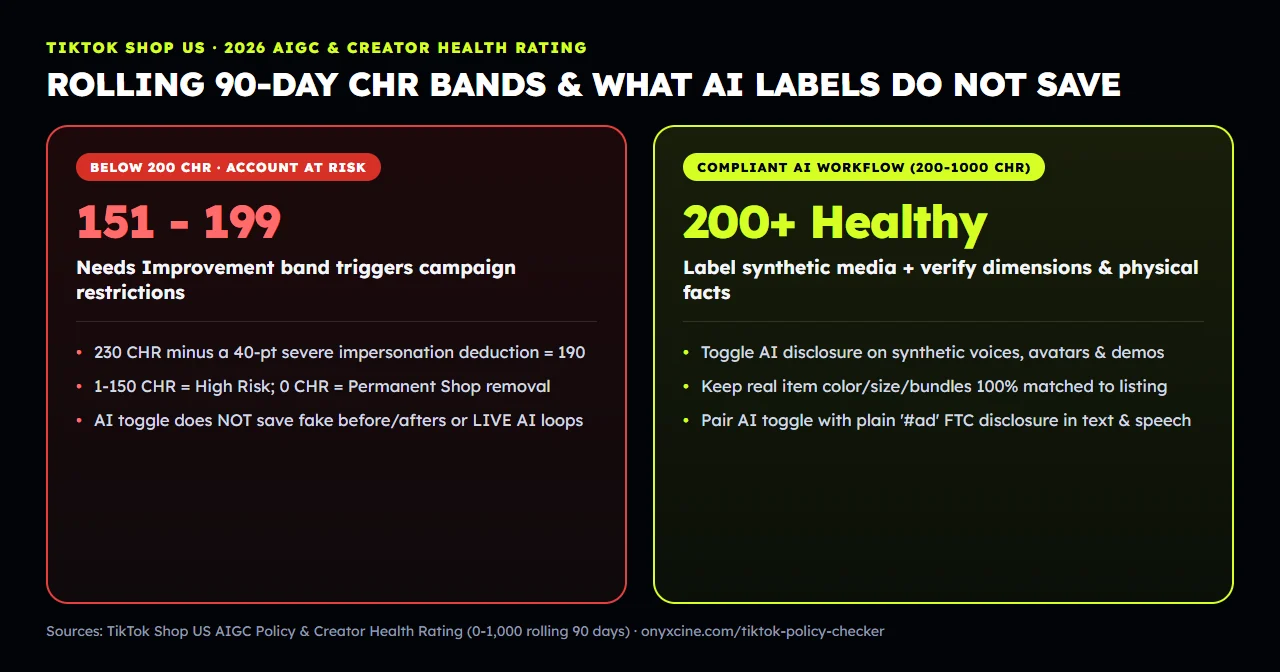
The problem is that new affiliates are new to rolling 90-day point deductions. The way to get new ideas is to notice anomalies: what seems strange, or missing, or broken? Honestly, I expected the number of account restrictions from pages with traffic under TikTok Shop US Creator Health Rating documentation (0 to 1,000 rolling 90-day score inside Creator Center -> Account Standing / Violations) to have a stronger correlation than a single 40-point high-severity violation pushing a 230 score straight below the 200+ Healthy threshold.
Why did a creator's yellow shopping cart stop attributing conversions while their video stayed visible on their profile? That's true if you look at your system as some kind of unknowable black box, but it turns out to be untrue in practice once you check how the three bands escalate below 200:
- 151–199 (
Needs Improvement): Sample approvals tighten, promotional tool perks stall, and sellers filter your profile out during campaign recruitment. - 1–150 (
High Risk): Heavy distribution suppression and shopping-cart detachment where your clip stays visible on your profile while yellow-cart conversions stop attributing. 0(Permanent Shop Revocation): Severe or repeated hits (such as impersonating faces, synthetic before/after claims, or repeated 40-point high-severity violations) permanently strip TikTok Shop affiliate permissions.
Catch risky lines before uploading (real scan example)
The problem is that seller product bullet points are new to creator compliance screening. The way to get new ideas is to notice anomalies: what seems strange, or missing, or broken? Honestly, I expected the number of violation strikes from pages with traffic to come from intentional scams rather than creators copying aggressive seller listing lines like "clinically melts belly fat in 7 days" or "100% dermatologist cure".
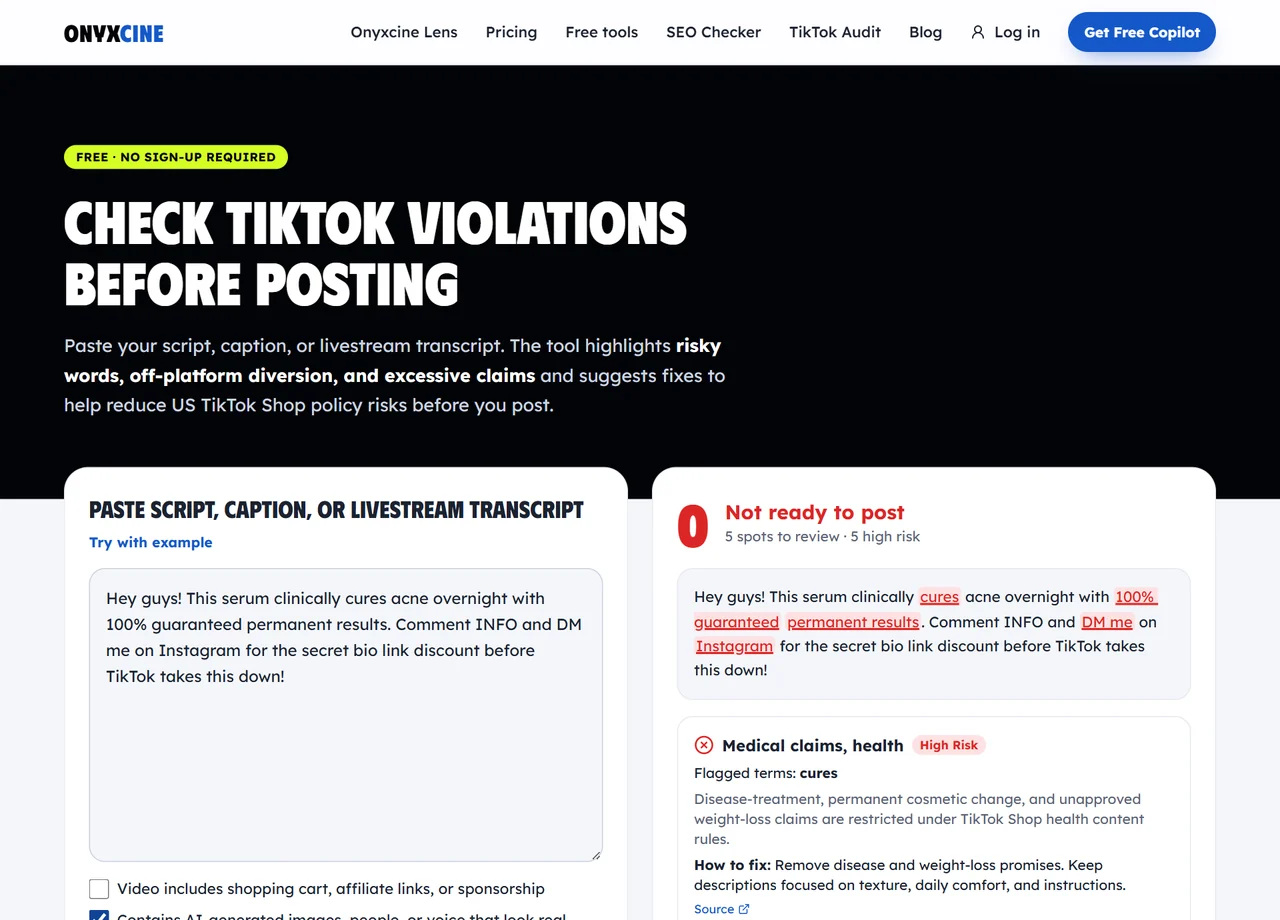
Why did a routine beauty script rack up five high-risk flags before checking with our free TikTok policy checker? That's true if you look at your system as some kind of unknowable black box, but it turns out to be untrue in practice once you paste every caption and voiceover draft into the scanner to catch exaggerated guarantee phrases, missing #ad placement, and prohibited medical language in five seconds before a 90-day CHR strike touches your account. When building multi-slide graphics instead of talking-head clips, see when TikTok Shop photo carousels beat short video to pair accurate product photography with readable comparison text cleanly.
Frequently Asked Questions
Can I get banned just for forgetting the TikTok AI-generated toggle?
One accidental oversight on harmless illustrative B-roll usually draws a label reminder or low-point warning, not an instant ban. Repeatedly publishing realistic fake product transformations, impersonations, or unlabelled synthetic endorsements stacks CHR points quickly and risks permanent ecommerce removal.
How long do violation deductions stay on TikTok Shop US Creator Health Rating?
Points deducted under CHR stay on your rolling ledger for 90 days from the enforcement date. Once 90 clean days pass, individual deductions expire automatically back toward a healthy 200+ score unless severe cumulative strikes drop the account to 0 (Permanent Removal).
Does deleting a flagged TikTok Shop video remove the violation points?
No. Deleting an already-penalized video stops public complaints or extra manual review, but already-assessed CHR points stay on your 90-day ledger unless an official evidence-backed appeal overturns the ruling. Screen scripts before publishing.
Try it out
Drop your next TikTok Shop voiceover and caption into our free TikTok policy checker before uploading, and check our FTC affiliate disclosure checklist to lock clean #ad + Commission Paid formatting across every clip.