It's better to make a few real buyers happy than to make a lot of casual visitors semi-happy. But I think that being willing to publish tests that have a good chance of showing our own blind spots is a deeply ingrained enough habit that it's not worth hiding when small business blogs stack articles in a chronological feed where good troubleshooting posts slip to page 3 as zero-link orphans and I can't think of another place where the gap is nearly as high as it is between publishing 500 disconnected posts and grouping 1 pillar guide plus 5 to 12 focused satellite articles under a clean Topic Hub within 3 clicks or fewer of the homepage. Honestly, I expected the number of indexed articles from pages with traffic on small sites to have a stronger correlation with raw post count than with eliminating orphan pages and linking every satellite back up to its Pillar, Topic Hub, and interactive tool.
The problem is not the actual time it takes to add two contextual internal links when publishing a new article. The problem is that once you start relying on sitemap.xml or bloated 40-link footers to carry orphan posts, publishing without updating older winners becomes the top idea in your mind. That's true if you look at your system as some kind of unknowable black box, but it turns out to be untrue in practice.
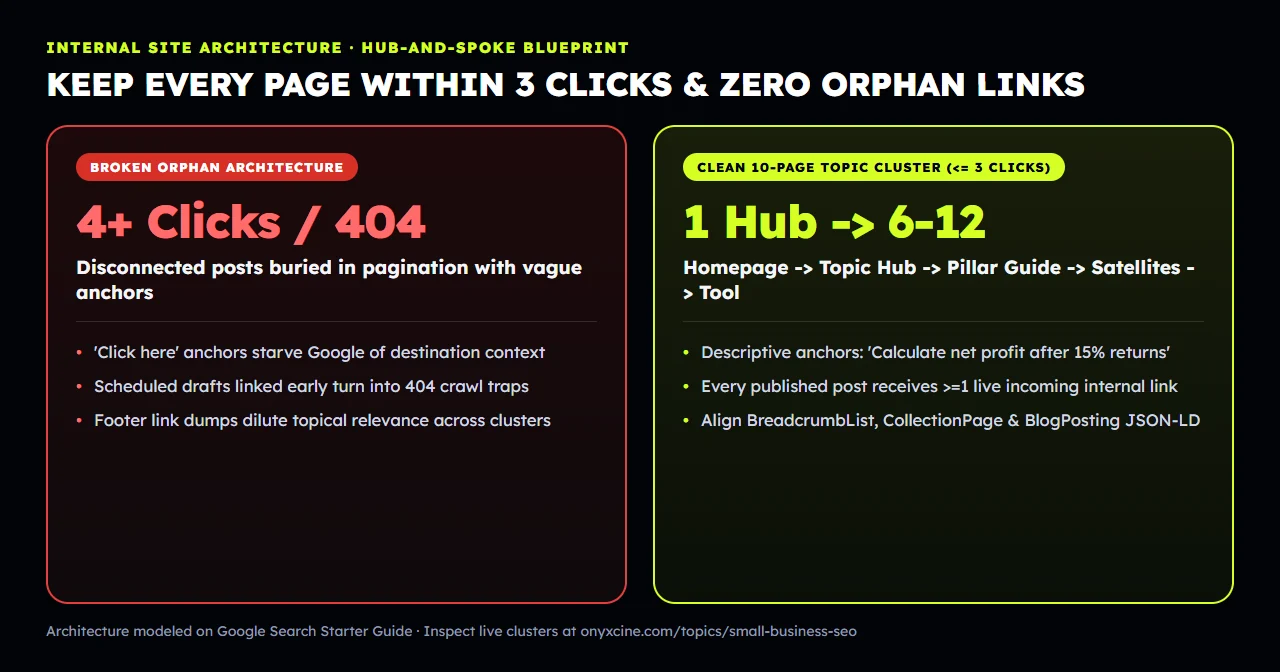
The 3-tier layout we run on Onyxcine
The problem is that chronological blog feeds are new to hub-and-spoke topic architecture. The way to get new ideas is to notice anomalies: what seems strange, or missing, or broken? Honestly, I expected the number of crawled guides from pages with traffic to have a stronger correlation than organizing every URL across three predictable tiers (as we do on AI Search Visibility, Small-Business SEO, and Tools for TikTok Shop & Sellers):
- Topic Hub (
/topics/...): A short directory page introducing the overall subject and listing every live pillar, supporting guide, and free interactive tool on that theme. - One Pillar Guide (
Why ChatGPT can't see your website/ core workflow): A practical 1,200+ word master walkthrough covering the overarching problem end to end and linking out to specialized deep-dives. - 5–12 Focused Satellites: Single-question guides (for example,
robots.txttemplates, Schema JSON-LD, or Core Web Vitals) that answer one distinct sub-problem cleanly without cannibalizing each other, linking back up to the Pillar and Topic Hub plus 1–2 relevant free tools like our SEO Checker.
| Cluster element | Ideal target per cluster | Main linking rule |
|---|---|---|
| Topic Hub page | 1 indexable directory page | Reached in 1–2 clicks from main blog/header; lists all published guides |
| Pillar Guide | 1 broad end-to-end guide | Links down to satellites & free tools; linked prominently at top of Hub |
| Satellite posts | 5–12 focused single-intent posts | Link back up to Pillar + Topic Hub + natural adjacent next-step posts |
| Tool pages | Interactive calculators/checkers | Linked contextually inside Try It Out & worked examples (Try the SEO Checker) |
Natural anchor text vs. over-optimized spam
The problem is that old exact-match SEO habits are new to reader-first context. The way to get new ideas is to notice anomalies: what seems strange, or missing, or broken? Honestly, I expected the number of clicks on internal links from pages with traffic to have a stronger correlation than following Google's SEO Starter Guide by writing anchors the way a colleague sends a Slack link ("run your page through our free SEO Checker" or "check our guide on why ChatGPT misses small sites") and avoiding two bad habits:
- Vague anchors:
"Read more","Click here", or"this post"give search engines zero context about the target URL. - Exact-match robotic stuffing: Repeating
"best free TikTok Shop commission calculator tool 2026"five times across unrelated paragraphs looks manipulative and reads painfully to US buyers.
Keep crawl depth <= 3 clicks and squash orphans
The problem is that XML sitemaps are new to fixing internal link authority. The way to get new ideas is to notice anomalies: what seems strange, or missing, or broken? Honestly, I expected the number of rankings on orphan URLs (any live page with zero internal <a href> links pointing to it from elsewhere on the domain) from pages with traffic in sitemap.xml to have a stronger correlation than verifying three fast rules every time you ship a new post.
Why did a newly published guide stall in Search Console before checking its target landing page inside our free SEO Checker? That's true if you look at your system as some kind of unknowable black box, but it turns out to be untrue in practice once you verify:
- Homepage -> Blog/Hub -> Post in
<= 3clicks: Walk the click path in a browser or crawler, not just in your CMS database, and never point<a href>links at scheduled posts that still return404. - Link older winners to the new post: Every time a new satellite goes live, open 2 older live articles in that cluster and add one genuinely useful sentence linking to the new guide.
- Verify crawlability, canonical tags, and page health together: Pair clean cluster structure with sitemaps and IndexNow fast indexing so both Google and Bing discover updated hubs swiftly.
Frequently Asked Questions
How many articles make a real topic cluster?
Five to twelve tightly scoped guides around one Topic Hub and one Pillar works well for most small sites. Stop adding satellites once new post ideas overlap heavily with existing headlines; update the existing winner instead of splitting rankings across two half-posts.
Should every satellite link to all other satellites in the cluster?
No. Force-linking 11 unrelated URLs at the bottom of every post clutters mobile screens. Link up to the Hub and Pillar consistently, plus 1–2 genuine next-step reads inside the body prose.
Does listing an article in `sitemap.xml` fix orphan status?
No. A sitemap helps discovery, especially on new sites, but cannot replace real internal HTML links from your navigation, hub pages, and related guides. Fix orphans inside your site structure first.
Try it out
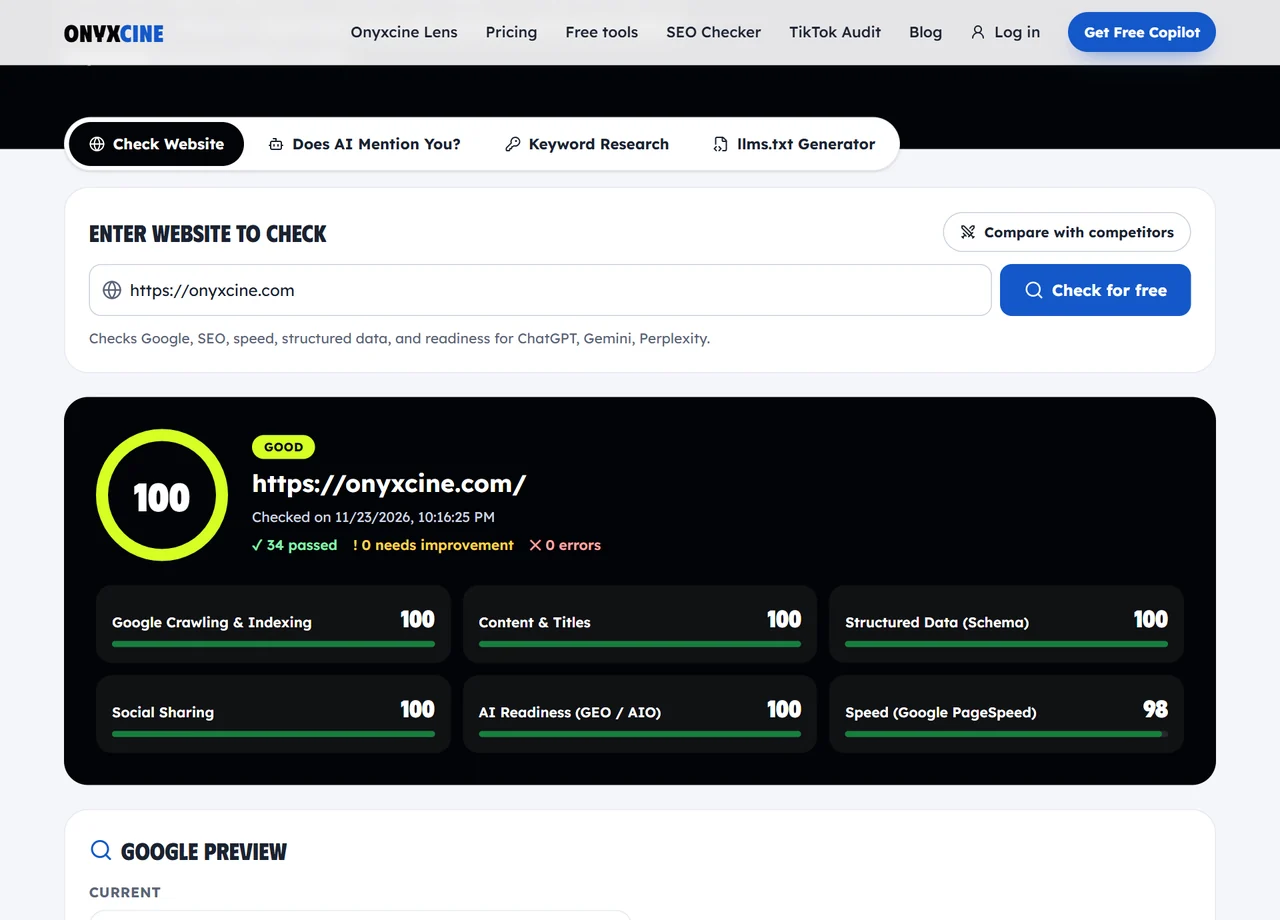
Run one core landing page and one deeper blog article through the free SEO Checker to confirm indexability and schema health, then click from your homepage to three older posts in your catalog to ensure every page sits inside 3 clicks.