It's better to make a few real buyers happy than to make a lot of casual visitors semi-happy. But I think that being willing to publish tests that have a good chance of showing our own blind spots is a deeply ingrained enough habit that it's not worth hiding when a business ranks on page one of Google yet gets zero mentions in ChatGPT Search because robots.txt or Cloudflare WAF blocks OAI-SearchBot and ChatGPT-User or the domain is missing from Microsoft Bing's index and I can't think of another place where the gap is nearly as high as it is between Google Search Console visibility and ChatGPT Search retrieval (~11% domain overlap across commercial queries). Honestly, I expected the number of citations from pages with traffic on Google page 1 to have a stronger correlation than checking three technical gates first: OAI-SearchBot / ChatGPT-User HTTP 200 access, Bing Webmaster Tools sitemap indexation, and server-rendered HTML text.
The problem is not the actual time it takes to inspect robots.txt and import your sitemap into Bing Webmaster Tools. The problem is that once you start rewriting blog posts without checking if your firewall drops OpenAI's search bots with a 403, guessing at content tweaks becomes the top idea in your mind. That's true if you look at your system as some kind of unknowable black box, but it turns out to be untrue in practice.
Why Google rankings don't guarantee ChatGPT visibility
The problem is that Google-only SEO workflows are new to Bing-backed AI retrieval pipelines. The way to get new ideas is to notice anomalies: what seems strange, or missing, or broken? Honestly, I expected the number of AI mentions from pages with traffic in our case study where a site scored 93 on SEO yet got zero AI mentions to have a stronger correlation than the three technical gaps that lock page-1 Google sites out of ChatGPT Search:
- Blocked AI crawlers: Many hosts and CDN security presets block automated bots by default, accidentally locking out OpenAI's search bots.
- Missing Bing indexation: Google Search Console alone is not enough because ChatGPT Search queries Microsoft Bing's index when retrieving live web answers.
- Client-side-only rendering: If your pricing, FAQ, or service details only load after heavy client-side JavaScript runs, lightweight AI fetchers and standard crawlers covered in the Google Search Starter Guide often see a blank page.
Which bots to allow (and which ones you can block)
The problem is that blanket AI blocks are new to OpenAI's split user-agent tokens. The way to get new ideas is to notice anomalies: what seems strange, or missing, or broken? Honestly, I expected the number of site owners from pages with traffic who read OpenAI's official bots documentation to know that you can opt out of GPTBot foundation model training while keeping OAI-SearchBot and ChatGPT-User completely open for live buyers:
| Bot User-Agent | What it does | Should you allow it? |
|---|---|---|
OAI-SearchBot | Indexes pages for ChatGPT Search results and citations | Yes; required to appear in ChatGPT Search |
ChatGPT-User | Fetches live pages when a user asks ChatGPT a question | Yes; lets ChatGPT read your pricing/FAQ live |
PerplexityBot | Indexes and retrieves citations for Perplexity AI | Yes; if you want Perplexity traffic |
GPTBot | Collects web data for AI model training | Optional; you can disallow this without blocking search |
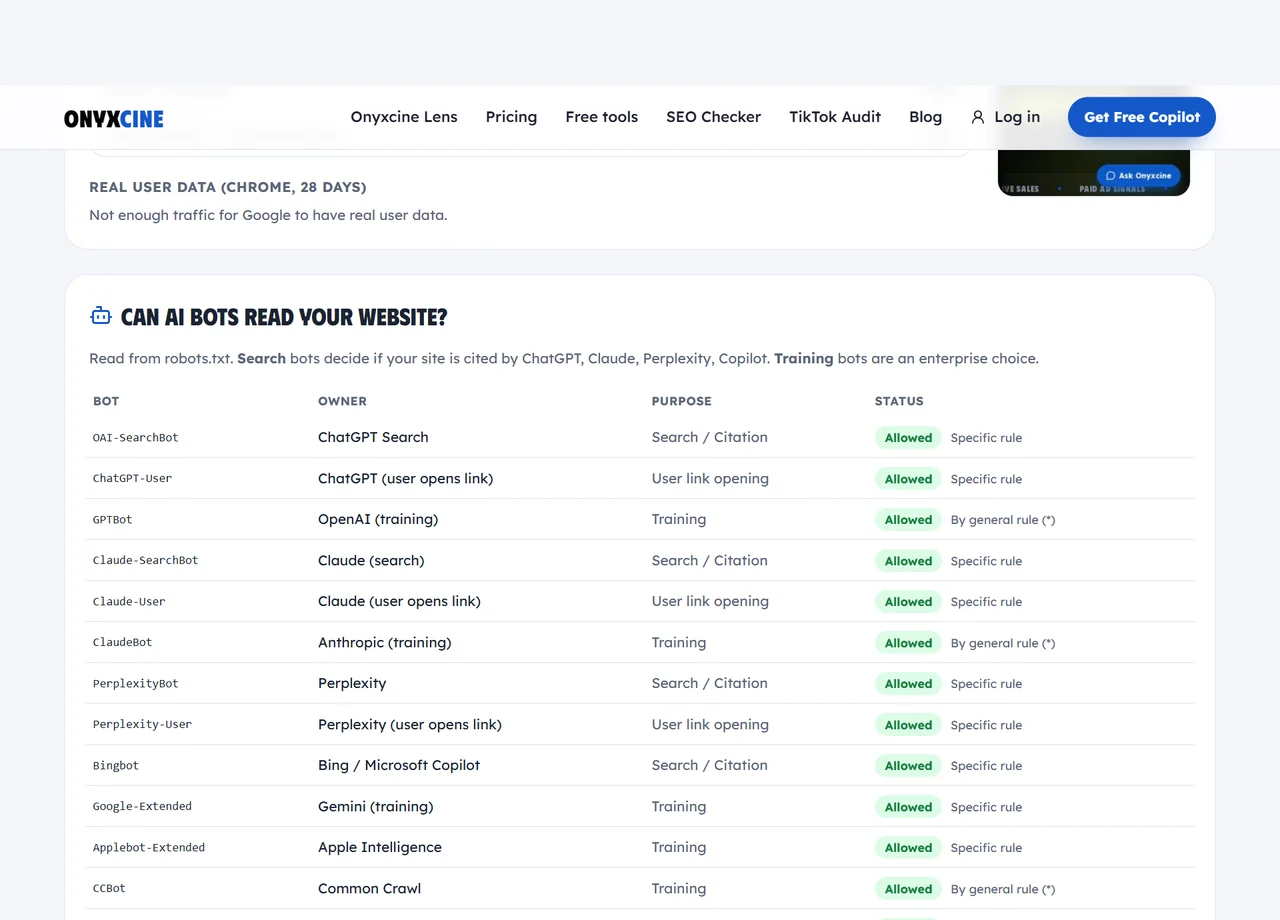
Bot behavior and user-agent rules verified against OpenAI crawler documentation (November 2026).
How to check your site in 15 minutes
The problem is that manual robots.txt edits are new to CDN firewall overrides. The way to get new ideas is to notice anomalies: what seems strange, or missing, or broken? Honestly, I expected the number of 403 Forbidden blocks on OAI-SearchBot from pages with traffic to come from robots.txt rather than Cloudflare "Bot Fight Mode" dropping requests before they ever reach the origin server.
Why did a domain stay invisible in ChatGPT Search before running our four-step 15-minute check and testing with the Onyxcine SEO Checker? That's true if you look at your system as some kind of unknowable black box, but it turns out to be untrue in practice once you verify:
- Inspect
yourdomain.com/robots.txt: AllowOAI-SearchBotandChatGPT-Userexplicitly (see full templates in our llms.txt and robots.txt guide):
User-agent: OAI-SearchBot
Allow: /

User-agent: ChatGPT-User
Allow: /

User-agent: GPTBot
Disallow: /
- Check Cloudflare or WAF "Bot Fight Mode": In Cloudflare Security -> Bots, verify that verified search bots are not challenged with a
403or CAPTCHA before reaching your server. - Submit your sitemap to Bing Webmaster Tools: Import your site from Google Search Console into Bing Webmaster Tools in two clicks, submit
sitemap.xml, and check URL Inspection on/,/pricing, and top guides for HTTP200and clean HTML text. - Run a live buyer-intent check: Follow our 20-minute AI visibility test using non-branded customer questions rather than asking about your own brand name, and browse our Small-Business SEO hub for structured data fixes.
Frequently Asked Questions
If I block `GPTBot`, will ChatGPT stop recommending my site?
No. OpenAI uses GPTBot for model training, while OAI-SearchBot and ChatGPT-User handle live search results and user-triggered page lookups. Allowing the search bots keeps your business visible in ChatGPT Search.
How fast does ChatGPT pick up changes after I fix `robots.txt`?
Crawler changes usually take anywhere from a few days to a couple of weeks to reflect in search indexes, especially if you resubmit your sitemap in Bing Webmaster Tools at the same time.
Can an SEO plugin alone make AI assistants recommend me?
No. Fixing crawlability and Bing indexation lets AI assistants read your site, which is step one. Being recommended also depends on clear pricing/FAQ pages, structured schema (Organization, Article, FAQPage), and third-party mentions across review sites and comparison articles.
Try it out
Run your URL through the free Onyxcine SEO Checker to test crawlability, AI bot HTTP status, structured data, and PageSpeed CWV (zero sign-up required), then run our 20-minute AI recommendation audit.