
It's better to make a few real buyers happy than to make a lot of casual visitors semi-happy. But I think that being willing to publish tests that have a good chance of showing our own blind spots is a deeply ingrained enough habit that it's not worth hiding when small publishers wait weeks for search bots to find an updated pricing table or overwrite every <lastmod> timestamp on every build so crawlers start ignoring their sitemap altogether and I can't think of another place where the gap is nearly as high as it is between relying on /sitemap.xml alone (since Google does not participate in IndexNow) and pairing a clean canonical /sitemap.xml (<= 50,000 URLs / 50 MB) with /rss.xml and real-time IndexNow API pings via IndexNow documentation for Bing and ChatGPT Search. Honestly, I expected the number of rapid index updates from pages with traffic to have a stronger correlation with manual Search Console requests than with automating all three release-day discovery channels together.
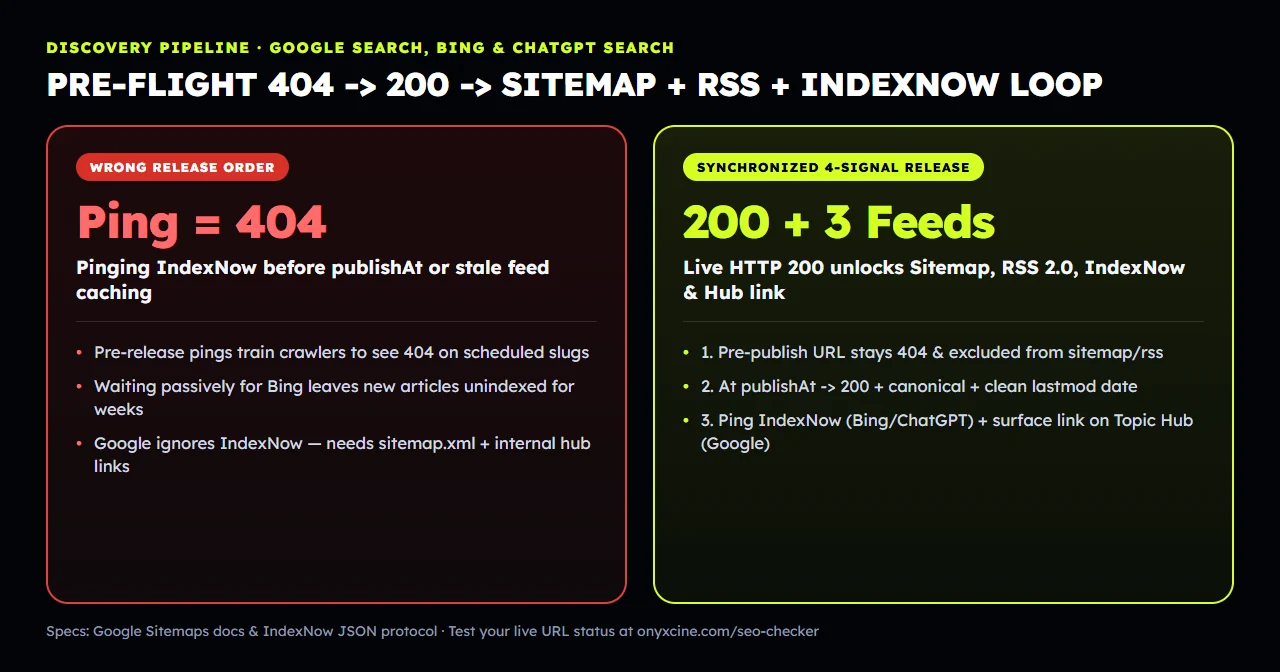
The problem is not the actual time it takes to POST a changed URL to https://api.indexnow.org/indexnow. The problem is that once you start shipping sitemaps containing scheduled 404 slugs, 301 redirects, or fake daily <lastmod> dates, teaching crawlers to distrust your discovery files becomes the top idea in your mind. That's true if you look at your system as some kind of unknowable black box, but it turns out to be untrue in practice.
1. Keep sitemap.xml small, accurate, and canonical
The problem is that auto-generated CMS sitemaps are new to strict <lastmod> hygiene. The way to get new ideas is to notice anomalies: what seems strange, or missing, or broken? Honestly, I expected the number of ignored sitemaps from pages with traffic under Google's Build and Submit a Sitemap guide to come from XML syntax errors rather than violating three basic hygiene rules:
- Only touch
<lastmod>when real content changes: Updating<lastmod>across all 80 URLs on every build tells Google your dates mean nothing; tie<lastmod>directly to the post's genuine publish or edited date (capNhat/ file update timestamp). - Include
<image:image>entries for diagrams & charts: Attaching key cover and inline visual paths helps Google Image search index your original graphics cleanly alongside articles. - List only live
200 OKcanonical URLs below Google's per-file caps (50,000 URLs or 50 MB uncompressed per file), excludingnoindextags, parameterized pages,301redirects, and future scheduled posts.
2. Add rss.xml + IndexNow for Bing & ChatGPT Search speed
The problem is that Google-centric publishers are new to how Bing feeds ChatGPT Search. The way to get new ideas is to notice anomalies: what seems strange, or missing, or broken? Honestly, I expected the number of small business owners from pages with traffic to realize that while Google does not participate in IndexNow, Bing, Yandex, Naver, and Seznam listen to IndexNow in real time, which directly accelerates ChatGPT Search citations:
| Channel | Who reads it fastest | Practical rule |
|---|---|---|
/sitemap.xml | Googlebot & Bingbot | Canonical indexable 200 OK URLs + truthful <lastmod> only |
/rss.xml | Feed readers, aggregators, rapid polling bots | Clean <link>, <pubDate>, and <guid> per live post |
IndexNow HTTP ping | Bing + participating discovery engines | Trigger immediately after publish or significant edits |
To set up IndexNow without heavy plugins, place your plain-text hex key file at your domain root (https://yourdomain.com/<key>.txt), confirm it returns HTTP 200, and fire an automated JSON POST to https://api.indexnow.org/indexnow right after deploy per the official IndexNow docs (or enable Cloudflare Crawler Hints).
3. Clean discovery signals cannot rescue blocked HTML
The problem is that fast URL pings are new to server-level firewall and canonical verification. The way to get new ideas is to notice anomalies: what seems strange, or missing, or broken? Honestly, I expected the number of indexing stalls after an IndexNow ping to come from Bing queue delays rather than the origin server blocking OAI-SearchBot or Bingbot with a 403 or serving an empty client-side loading spinner.
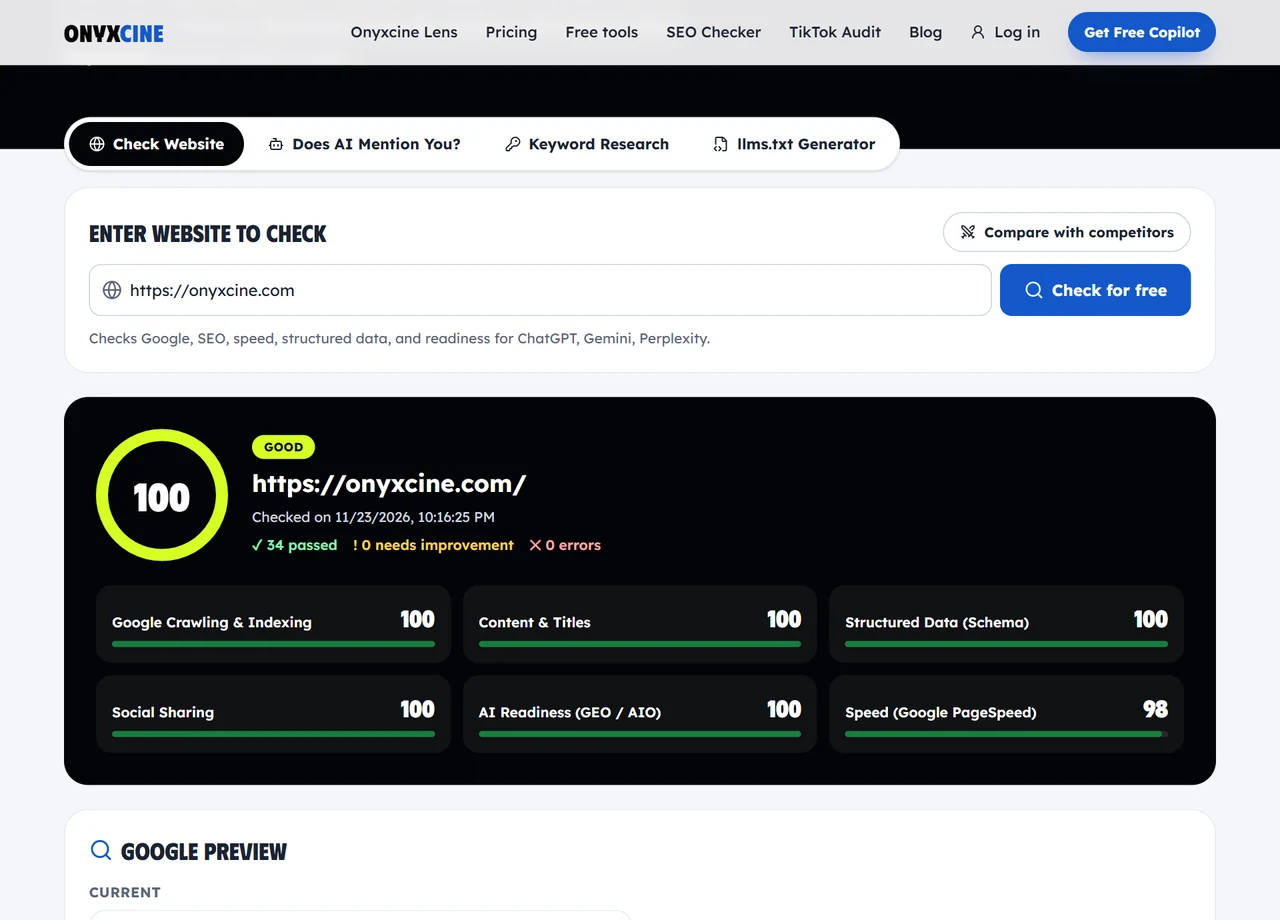
Why did a new article fail to index after pinging sitemap.xml and IndexNow before checking the URL inside our free Onyxcine SEO Checker? That's true if you look at your system as some kind of unknowable black box, but it turns out to be untrue in practice once you verify three server signals and pair them with our guide on why ChatGPT ignores sites that rank on Google:
- Exact HTTP
200status and non-blocked bot access (Googlebot,Bingbot,OAI-SearchBot,ChatGPT-User). - Clean server-rendered word count and valid
canonicalURL matching your sitemap entry character-for-character. - No hidden
robots.txtdisallows orX-Robots-Tag: noindexheader left over from staging.
Frequently Asked Questions
Does Google support the IndexNow protocol?
No. Google relies on Search Console sitemaps, internal HTML linking, and standard crawl scheduling. Use Search Console + clean sitemap.xml for Google, and pair IndexNow + Bing Webmaster Tools for Bing and downstream AI discovery.
Should scheduled or draft URLs appear inside `sitemap.xml`?
Never. Only expose pages already returning live 200 OK HTML. Listing future scheduled URLs before publish time produces 404 crawl errors and wastes search trust.
Can an XML sitemap force Google to rank an orphan page?
No. Sitemaps accelerate discovery, not authority or placement. Connect every important guide inside clear cluster pages and navigation; if you have orphans, fix those links right away.
Try it out
Check your live URL's server crawl health, robots.txt rules, and schema output inside our free SEO Checker, then verify that your /sitemap.xml includes accurate <lastmod> dates and zero 404 or redirected entries.